Research

We combine long-term fieldwork, new tracking and sequencing methods, and mathematical models to understand how animals build their social lives and what those lives do to them. Most of the work is on the rock hyraxes of Ein Gedi.

How social networks form and change

Animals do not pick their companions at random, and the networks they form are never fixed. We look for the simple rules that build a network. One of them is social inheritance: young animals copy their mother's ties. On its own, this rule reproduces the structure of real animal networks, and in spotted hyenas it explains how ties pass down the generations. Avoidances can be inherited too.

We also measure what a place in the network means for the animal holding it. In rock hyraxes, how evenly ties are spread within a group predicts how long its members live.
The social microbiome

Close contact moves microbes. With shotgun metagenomics of hyrax droppings we follow how gut bacteria pass between animals, down to the level of single strains. Current projects ask how social ties and diet shape each animal's microbiome, how strains spread between groups across the Judean Desert, and how the microbiome changes over time. Alongside them we are assembling the hyrax genome and a reference catalogue of hyrax gut microbes.

Songs and signals

Male rock hyraxes sing long, complex songs, with local dialects. Singing is costly, which makes a song an honest signal of the singer, and males that keep a steady rhythm father more young. We study how signals are built, how they evolved and how communication fits the social structure around it, and we think about what AI can and cannot tell us about animal communication.

Predators, landscapes and biodiversity

Social life happens under threat. A new project follows wolves and other predators around Ein Gedi with camera traps and DNA from droppings, to link them to the long-term hyrax data. We have used historical records and models to map habitat for a possible return of the Arabian leopard, and we are testing whether DNA caught in spider webs can reveal which species live nearby.

Study systems

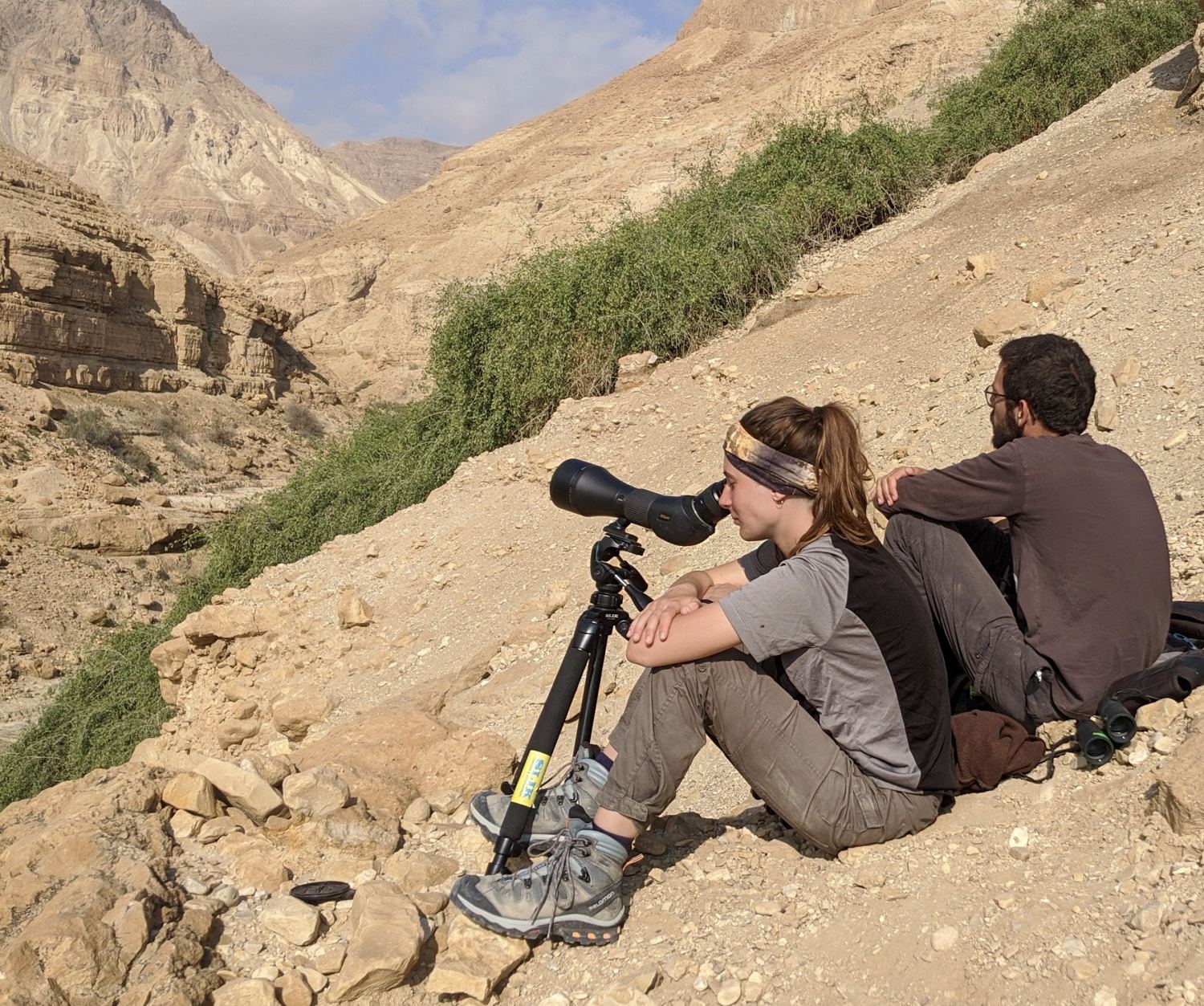
The rock hyrax population of Ein Gedi Nature Reserve, on the western shore of the Dead Sea, has been followed for more than 25 years: more than 600 animals at two study sites, observed, recorded and sampled year after year.

Beyond hyraxes we have worked on spotted hyenas, Arabian babblers, fruit flies, sharks and songbirds, and on theory that applies to any social species.

Two lab members on a desert slope, one looking through a spotting scope
Watching hyraxes through the spotting scope.